
Secrets to designing supertall structures: Insights from the creators of the tallest towers on the planet
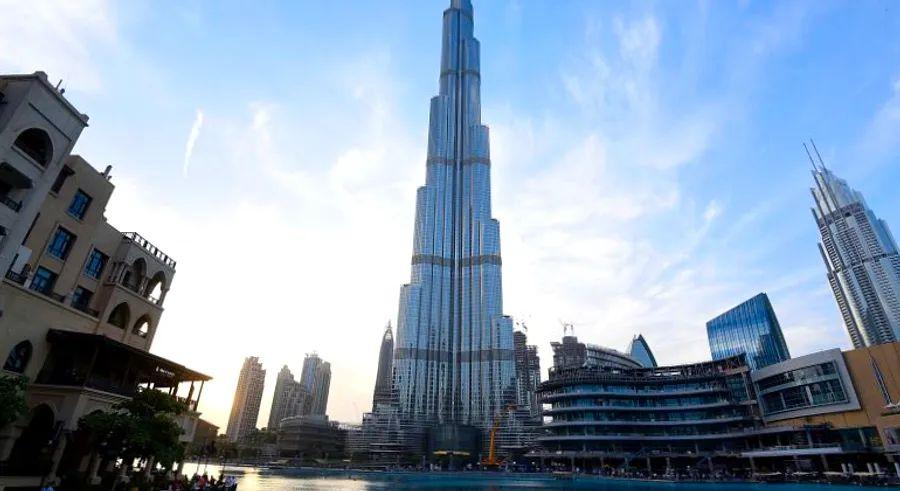
The Burj Khalifa, standing at 828 meters (2,717 feet), has towered over Dubai for over a decade, casting a massive shadow in the skyline and in the history of architecture. It didn't just break the height record; it surpassed its predecessor, Taipei 101, by an astonishing 62%. The impact of its legacy has been profound, especially for the architect behind it.
Adrian Smith, the visionary behind the Burj Khalifa, was working with Skidmore, Owings & Merrill (SOM) when the design was conceived. However, by the time the iconic structure was completed in 2010, he had already co-founded his own firm, Adrian Smith + Gordon Gill Architecture (AS+GG), which specializes in designing supertall and megatall skyscrapers over 300 meters and 600 meters in height, respectively.
Supertall skyscrapers are still quite rare, with just 173 completed worldwide, while megatalls are even more exceptional, with only three currently standing, according to the Council on Tall Buildings and Urban Habitat (CTBUH). Many ambitious projects never make it past the planning stage. As Adrian Smith noted, there are few real-world examples to study in this field.
According to Smith, the true learning experience begins only once the building is finished. “Everything before that is just paperwork,” he said, which is why structures like the Burj Khalifa continue to be so significant and impactful in the architectural world.
“Looking back at a project completed 15 years ago to assess how it has held up, how it’s performing, and speaking with people about their experiences with the building—there’s no greater insight than that,” Gill remarked. “Nothing compares to that kind of feedback.”
For over 15 years, AS+GG has built an impressive portfolio of skyscrapers across Asia, North America, Europe, and the Middle East. These remarkable designs have now been brought together in a new book titled “Supertall | Megatall: How High Can We Go?”
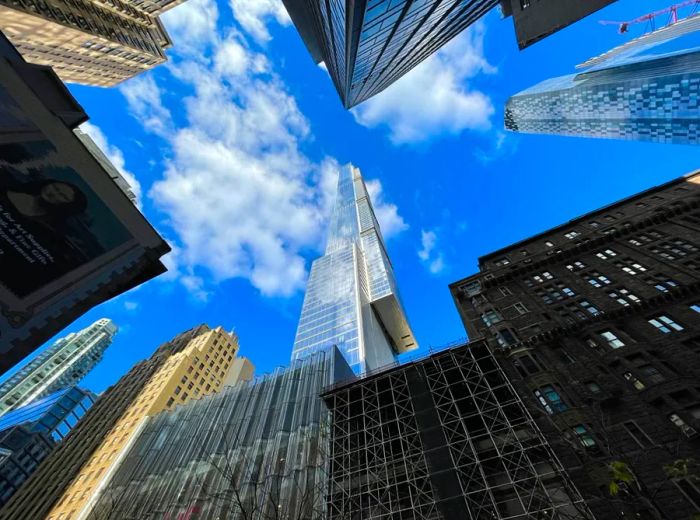
This comprehensive book serves as both a practical resource for students and a guide for professionals in the field of architecture. Filled with detailed technical drawings, it explains the groundbreaking innovations behind skyscrapers such as the recently completed Central Park Tower in New York (472 meters), the upcoming Chengdu Greenland Tower (468 meters) in China, and visionary projects soaring over one kilometer high. It's a look at the future of architecture, exploring where skyscrapers might go next.
“It’s astonishing how few people truly understand how a supertall building works,” said Smith, referring to the topic as “mostly unknown territory.”
So why is the firm eager to reveal its design insights?
Great ideas are never wasted.
AS+GG’s most renowned design is the Jeddah Tower (formerly called the Kingdom Tower) in Saudi Arabia.
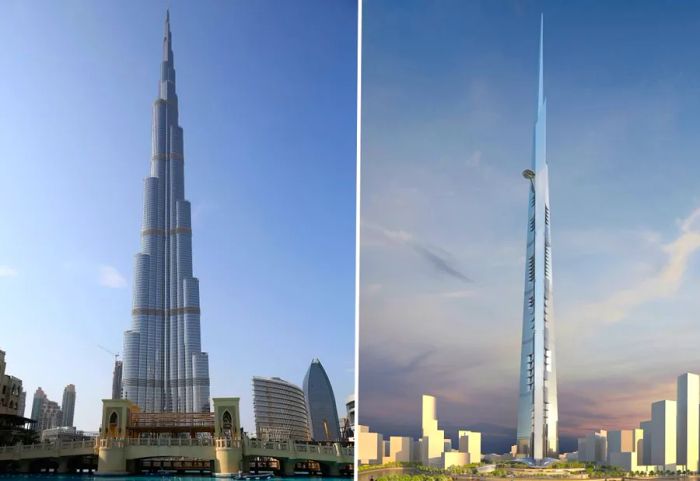
When completed, the Jeddah Tower is expected to soar over 1,000 meters, making it the tallest structure in the world. Initially set for completion in 2020, by that year the building had reached 58 floors, according to “Supertall | Megatall,” though it has faced delays.
Smith mentioned that the constructors have “protected every necessary aspect” and assured that “the building is not showing any signs of deterioration.” In response to questions about its potential resumption, Gill remarked, “Never say never.”
The Jeddah Economic Company, which is overseeing the development of the Jeddah Economic City where the tower is located, did not respond to a request for comment regarding the building’s current status by the time of publication.
One of the most detailed sections of the book is dedicated to the tower’s groundbreaking innovations, including extensive wind testing with a 1:4,000 scale model, methods for reducing solar radiation, and a condensate-recovery system capable of collecting enough water annually to fill 14 Olympic-sized swimming pools.
However, “Supertall | Megatall” highlights how the Jeddah Tower’s structural design builds upon and refines that of the Burj Khalifa, featuring a three-winged, Y-shaped configuration for enhanced stability. This concept is reminiscent of earlier designs like WZMH Architects’ CN Tower in Toronto. Smith also noted that both the Burj Khalifa and Jeddah Tower drew inspiration from the sleek, fully glazed Friedrichstrasse Skyscraper – a 1920s unrealized design by German-American architect Ludwig Mies van der Rohe.
Mies’ unbuilt design serves as “a perfect example of a concept that wasn’t realized yet still holds value,” Gill remarked. This likely explains why “Supertall | Megatall” also features AS+GG skyscrapers that never made it off the drawing board.
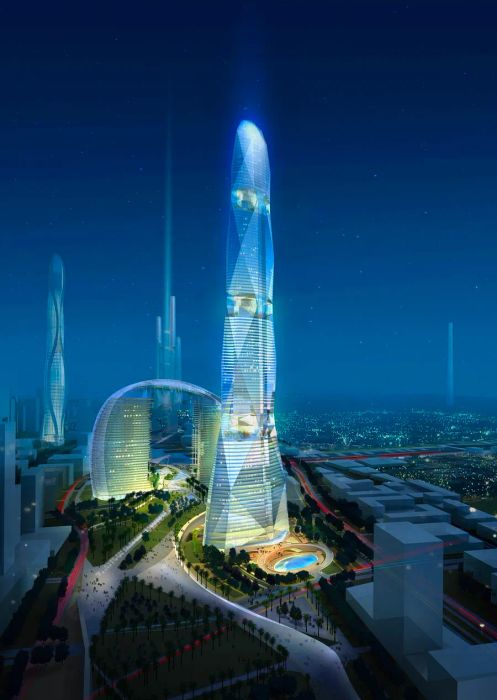
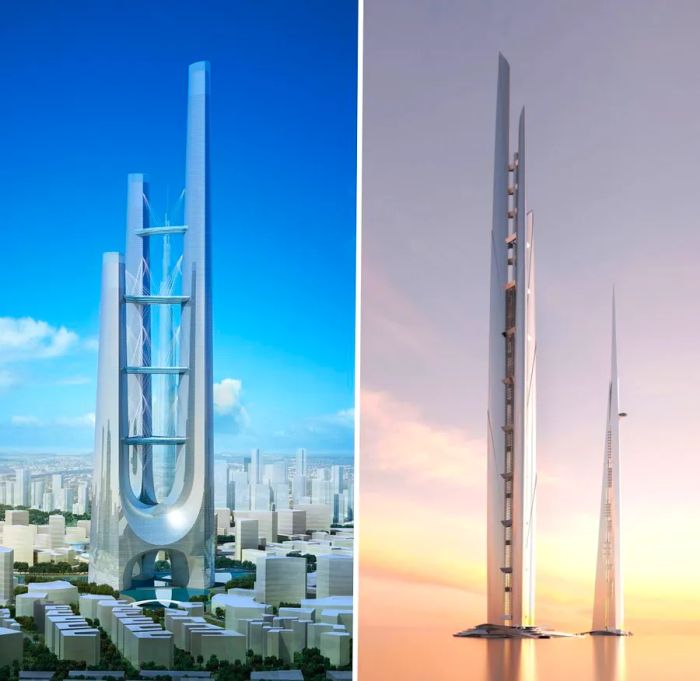
Many of the unbuilt designs are from Dubai, which, in fact, has more entries than any other city in the book. With its ambitious growth, Dubai has been a testing ground for audacious projects over the last two decades. Among the proposed AS+GG skyscrapers are the Meraas Tower (526m), Za’abeel Signature Tower I (598m), and 1 Dubai Atrium City (1,000m). While it’s exciting to imagine what the skyline might look like with these towers, much like Mies’ Friedrichstrasse, their absence hasn’t been without value.
“That’s why we referred to those unbuilt projects in the present tense in the book,” Forest explained. “It’s not a collection of forgotten concepts.”
According to Gill, countless lessons from these designs have already influenced other AS+GG projects. For instance, the development of the 1,000-meter “vertical city” 1 Dubai sparked extensive discussions on mechanical systems, structural efficiency, elevators, fire safety, lighting, air circulation, and more – all of which contributed to broader conversations about building at extreme heights.
In the final section of “Supertall | Megatall,” the evolution of 1 Dubai’s three slender, interconnected towers is explored in a series of prototypes for mile-high skyscrapers. These designs utilize three separate towers linked by a central structure to maintain stability.
“I believe a great idea is never wasted,” Gill remarked.
Designing for the unseen
For cities aiming to enhance their global presence, supertall skyscrapers can serve as a powerful symbol. “These buildings don’t go unnoticed,” Forest pointed out. “No matter who owns them, they become synonymous with their location.”
What succeeded in Dubai served as a template for Jeddah. However, height isn’t the only factor – nor is it always the firm’s primary focus (Smith noted that the drive to make the Burj Khalifa the world’s tallest came from the client, Emaar).
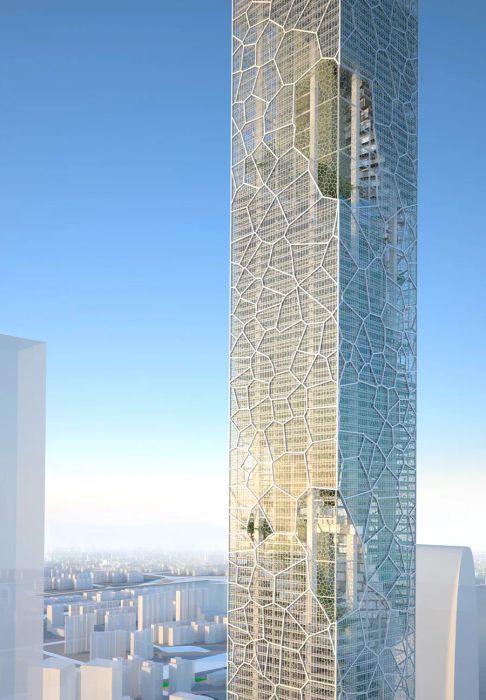
For AS+GG, height serves as a catalyst for solving a range of complex problems. This scale not only demands innovation but fosters it. The book suggests that supertall and megatall buildings offer opportunities to advance energy efficiency, reduce carbon footprints, and merge the built environment with nature through biophilic design. As Gill notes, “The economy of scale allows us to introduce ideas that have a lasting impact.”
The Biophilic Tower, an unbuilt design from 2012 intended for Suzhou, China, features unconventional elements, including a spiraling vertical forest spanning 119 floors, and solar shades modeled after the structure of leaves and honeycombs. Yet much of this innovation remains unseen, as Gill pointed out.
“Sometimes, I think people look at buildings and can’t quite comprehend what they’re seeing,” Gill remarked. “That’s because we’re often designing for the invisible … elements that the public never sees or interacts with. But they’re embedded in the science and the design. And it’s these elements that elevate the building.”
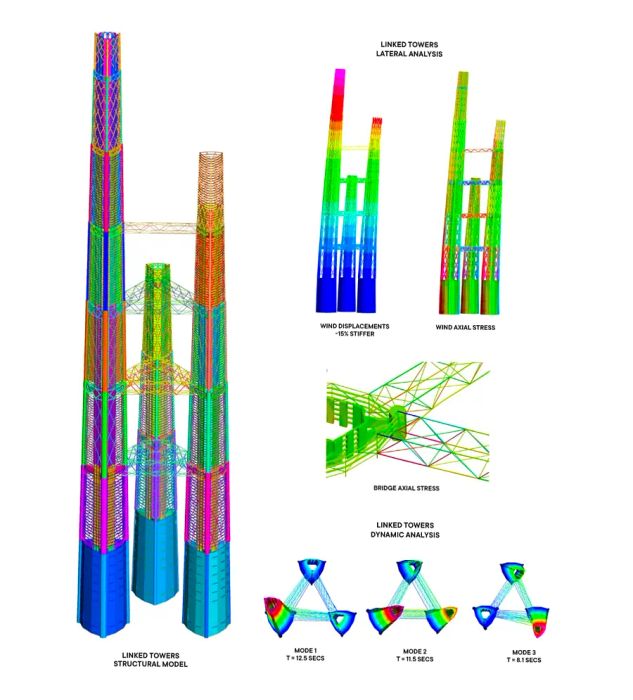
In "Supertall | Megatall," the unseen elements of skyscraper design take center stage. “The educational value of this book should not be overlooked,” remarked Smith, who, along with his partners, is eager to see AS+GG’s designs serve as a valuable industry resource. “As architects, it’s our duty to share our knowledge,” added Gill.
It turns out that the secrets behind supertall buildings aren’t meant to remain hidden at all.
1
2

3

4

5
Evaluation :
5/5